
Winchelsea Primary School
Maths
Our Curriculum – Maths

'All individuals matter'
Winchelsea Mathematics
Intent
A Winchelsea Mathematician will:
- Enjoy a lifelong interest in the subject.
- Reflect and make connections in their learning.
- Communicate clearly and confidently using mathematical vocabulary.
- Face challenges with resilience.
- Work independently, in pairs or in groups to fulfil their potential
We aim to provide a high-quality mathematics education for our children which aims to ensure that all pupils:
become fluent in the fundamentals of maths through varied and frequent practice with increasingly complex problems over time, so that pupils develop conceptual understanding and the ability to recall and apply knowledge rapidly and accurately
reason mathematically by following a line of enquiry, conjecturing relationships and generalisations and developing an argument, justification or proof using mathematical language
can solve problems by applying their mathematics to a variety of routine and non-routine problems with increasing sophistication, including breaking down problems into a series of simpler steps and persevering in seeking solutions

Implementation
Curriculum
. We work closely with the EME Maths Hub, ensuring our approach is research informed and engaging.

. From Reception to Year 2, we follow NCETM Mastering Number planning. Mastering Number lessons take place 4 days a week.
. From Year 1 to Year 6, White Rose Maths planning is the basis of the maths curriculum with adaptations made to ensure an inclusive classroom. Reception uses White Rose and Mastering Number for the basis of its planning. Daily maths lessons take place from the Foundation Stage to Year 6.

. The gradual release of responsibility underpins lesson design, from the modelling of key concepts through to confident, accurate, independent application.
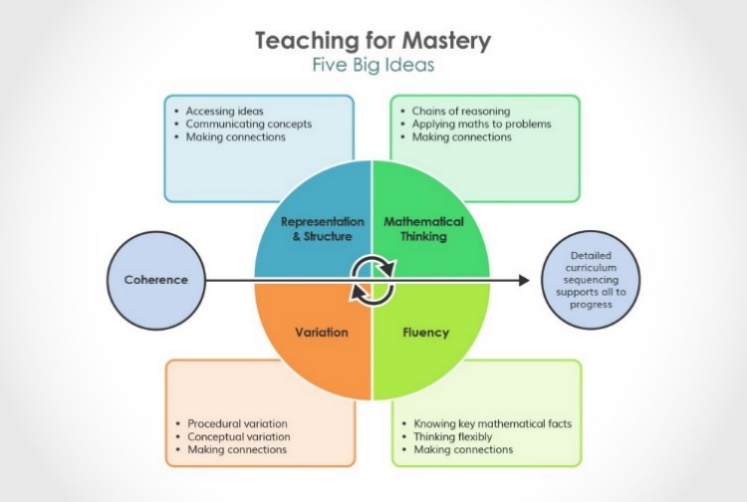
. Representation and structure – The CPA approach is followed to ensure all students can access the learning, understand the structures of a concept and make valuable connections with other concepts.
. Fluency – Lessons teach mathematical fluency through the recall of maths facts and learning how to make connections with other facts.
. Variation – The curriculum highlights what a concept is and is not to develop a deeper understanding of concepts.
. Mathematical thinking – Reasoning is embedded throughout lessons so students can reason mathematically and apply that reasoning to a variety of maths problems.
. Coherence – Lessons are adapted to ensure all students can access all lessons and children travel on the learning journey together.
. Additional provision to support maths learners includes Mathletics and Times Tables Rock Stars.
. To inspire the next generation of mathematicians, local and wider career opportunities are celebrated and explored throughout school.
Assessment
. Daily assessment is incorporated throughout the ‘White Rose Maths’ and ‘Mastering Number’ lessons through live and verbal feedback.
. Where children require additional support, interventions are used to support children ensuring that they are ready for the next ‘small step’.
. Termly White Rose Maths assessments are used to identify children’s progress and next steps in learning. This makes up a termly summative assessment point to support teacher judgements.
. To inspire the next generation of mathematicians, local and wider career opportunities are celebrated and explored throughout school.
Impact
By the end of Year 6, as students transition to secondary school, we aim for a Winchelsea mathematician to have built a solid foundation of efficient and accurate calculation skills. These skills will be grounded in the C-P-A approach, ensuring that students grasp the underlying concepts, not just the procedures. This understanding will empower them to recognise when answers are mathematically incorrect. Students will be able to apply their calculation skills and broader mathematical knowledge to become confident, resilient problem-solvers, capable of reasoning through challenges and articulating their mathematical ideas clearly.

Home learning
Children are encouraged to learn their basic number facts and times tables. We enjoy using TTrockstars.

We use Mathletics, an online platform to use and apply our maths skills as part of our home learning.
